Someone to Meet in the Next World

One of the most astonishing accounts in modern times is Dr. Eben Alexander’s Proof of Heaven.  It made a splash when published in 2012, because this was a near-death experience (NDE) unlike any other.  Beforehand, Alexander was a skeptic about the after-life and about NDEs.  He was an unsentimental and successful neurosurgeon who believed, like many in the medical community, that NDEs were hallucinations created by neuro-transmitters continuing to fire in the brain when consciousness ceased.  But his own illness seemed specifically designed to undermine that theory.  He was suddenly overcome by a rare meningitis that not only placed him in a coma but shut down his brain.  All the specialists involved told his family that if he ever recovered from his coma he would be a vegetable.  After a week they were just about to “pull the plug” when he opened his eyes and began talking.  He was completely cured and no one could understand how.  But we might understand the why.  I have not finished the book yet much less rendered a decision on how kosher its theology is.  But Alexander’s life since then reminds me of Mark Helprin’s epigram to Winter’s Tale:

I have been to another world, and come back. Listen to me. 

Near the beginning of his experience, Alexander finds himself flying without an aircraft over a paradisical land. Assuming it is true and not a hallucination it reminds us that mystic wonder has more to do with people than place.  And it gives a rock solid glimpse of what “higher and holier” means. 

Proof of Heaven

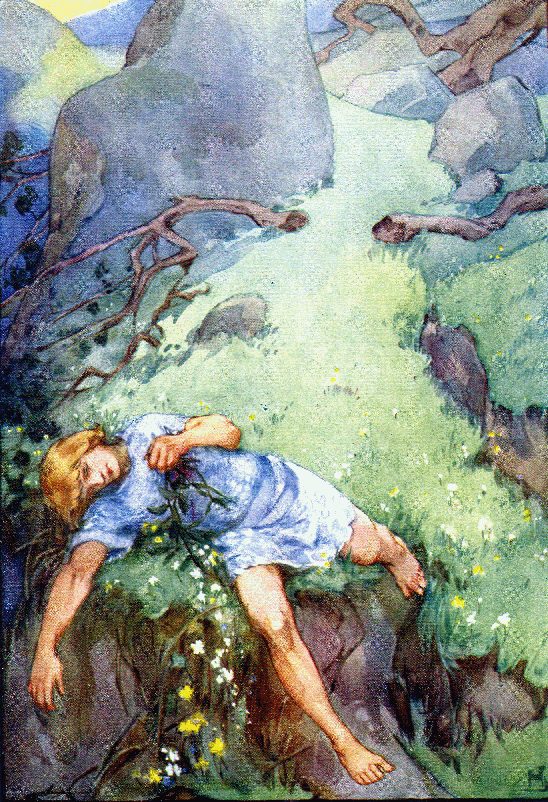
Someone was next to me: a beautiful girl with high cheekbones and deep blue eyes.  She was wearing the same kind of peasant-like clothes that the people in the village down below wore. Golden-brown tresses framed her lovely face….

The girl’s outfit was simple, but its colors–powder blue, indigo, and pastel orange-peach–had the same overwhelming, super-vivid aliveness that everything else in the surroundings had.  She looked at me with a look that, if you saw it for a few moments, would make your whole life up to that point worth living, no matter what had happened in it is so far.  It was not a romantic look.  It was not a look of friendship. It was a look that was somehow beyond all these…beyond all the different types of love we have down here on earth.  It was something higher, holding all those other kinds of love within itself while at the same time being more genuine and pure than all of them.

In the end of the book, Dr. Alexander, who was adopted as a baby, is given an old photo and discovers this girl is his birth-sister whom he never knew.

See it on Amazon

Proof of Heaven: A Neurosurgeon’s Journey to the Afterlife, by Dr Eben Alexander.  New York: Simon & Schuster, 2012.  Copyright 2012 by Dr. Eben Alexander.  All rights reserved.

God Arrives without Angel Disguise

We continue with mystical experiences of the Bible.  After the Fall in Genesis 3 and the calling of Abraham in Genesis 12 this may be the most important hinge in the Old Testament.  God tells Moses that he is the man to defy Pharaoh and lead hundreds of thousands of Israelites out of their slavery in Egypt.  Moses’ response of course is “Not me! I am not the person for such a job!”

burning-bush-exodus-moses

What we see in the Exodus passages are people meeting the awesome strangeness and other-ness of God—an experience of the Numinous, as Rudolf Otto described it.  In Genesis after the Fall, God shows up only in disguise, so to speak: as a voice, as angels, as a vision while asleep. In Exodus the mission is apparently so critical that he shows up without disguise. There is so much at stake: His people must know who He is; hundreds of thousands of them must walk out of Egypt not only unscathed but rich; Pharaoh’s gods and magicians must be publicly defeated; the people must never forget this God is their rescuer and redeemer who can do absolutely anything; a new nation with unprecedented laws of justice, mercy, and reverence must begin, a way of life that God intends to spread over the earth and end evil forever. 

But God coming without disguise creates a confrontation with absolute holiness.  God is love, but God is also absolute goodness, and in His presence we do not need to be told that we are very much not.  Moses hides his face.  For the same reason, centuries later, Peter will tell Jesus, “Go away from me, for I am sinful man.”  

This is also the momentous time when God reveals his true, personal name, not a title. Often transliterated from the Hebrew as YHWH, it is mysterious and so is its pronunciation.  But it seems to mean “I Am Who I Am,” that is, the self-subsistent one; the only one that cannot be compared to or depend upon anything else. 

Exodus 3: God, The Fire that Never Goes Out, Speaks to Moses

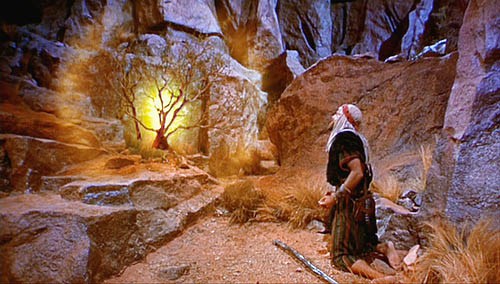
Moses was shepherding the flock of Jethro, his father-in-law, the priest of Midian. He led the flock to the west end of the wilderness and came to the mountain of God, Horeb. The angel of God appeared to him in flames of fire blazing out of the middle of a bush. He looked. The bush was blazing away but it didn’t burn up.

Moses said, “What’s going on here? I can’t believe this! Amazing! Why doesn’t the bush burn up?”

God saw that he had stopped to look. God called to him from out of the bush, “Moses! Moses!”

He said, “Yes? I’m right here!”

God said, “Don’t come any closer. Remove your sandals from your feet. You’re standing on holy ground.”

Then he said, “I am the God of your father: The God of Abraham, the God of Isaac, the God of Jacob.”

Moses hid his face, afraid to look at God.

God said, “I’ve taken a good, long look at the affliction of my people in Egypt. I’ve heard their cries for deliverance from their slave masters; I know all about their pain. And now I have come down to help them, pry them loose from the grip of Egypt, get them out of that country and bring them to a good land with wide-open spaces, a land lush with milk and honey….


Burning bush

Then Moses said to God, “Suppose I go to the People of Israel and I tell them, ‘The God of your fathers sent me to you’; and they ask me, ‘What is his name?’ What do I tell them?”

God said to Moses, “I-AM-WHO-I-AM. Tell the People of Israel, ‘I-AM sent me to you.’”

God continued with Moses: “This is what you’re to say to the Israelites: ‘God, the God of your fathers, the God of Abraham, the God of Isaac, and the God of Jacob sent me to you.’ This has always been my name, and this is how I always will be known.

–Exodus 3:1 – 8a; 13-15, The Message


A Prison, A Paradise: Time Travel

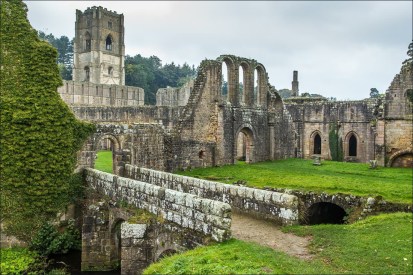
Fountains_Abbey_view_crop1_2005-08-27

Finishing up our selection from Gay Taylor’s pseudonymous memoir. Not long after the previous events, she and a friend visit the ruins of an Abbey and have one of the most astonishing experiences anyone has ever had. 

January 5th, 1948. The highlight of my visit, and one of the occasions of our lives, came on New year’s Eve. Alison and I went by a variety of buses to Ripon, and set off on a cloudy winter afternoon, in a taxi to the gates of Fountains Abbey.  I had clamoured for years to revisit it, for I had loved it as a child and had never seen it since. Fountains2-49We dismissed the taxi at the gates, walked by frost-whitened paths between silvery evergreens, then down towards the roar of the Skell [river] and the dim lovely ruins.

Repair-work was going on and scaffolding towered above the Chapel of the Nine Altars. As dusk fell, we stood together on the south side of the cloister-garth, looking north, towards the cedar and the great grass-grown walls and the tower. As as we stood silently watching, they began to change. 

fountains-abbey

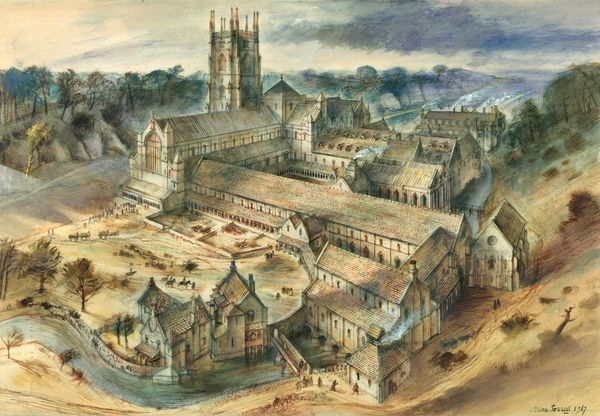
A soft, silvery-amber and quite unearthly light like warm moonlight lay over them.  But there was no moon; it was not due to rise for hours yet. In utter silence—where was the roar of the Skell?—the whole ruin changed, rebuilt itself: the walls were intact, the church and the Chapel of the Nine Altars became roofed and perfect. The pinnacled tower stood out newly finished, a deeper amber than the rest. The entire structure was silver-gilt in colour, and this colour seemed to be struck out of it by the silvery light in which it was bathed. We both stood awestruck, wordless, not moving, for what seemed a long time. “There’s no scaffolding,” breathed Alison at last in a soft amazed tone. I didn’t answer, for I thought, “Why should there by scaffolding? We’re seeing it as it was about 1520, when Huby’s tower was finished, and they’ve only just removed the scaffolding.” But then I realized that we were both seeing the same thing. She said later that she had meant the scaffolding that showed above the Chapel of the Nine Altars, where (certainly from the time and place in which we now were) there was no scaffolding.

We saw no Cistercian monks, brought back no useful information whatever, we merely stood for a timeless moment, for eternities or for ten minutes, seeing Fountains as it was a few years before the Reformation.

Fountains Abbey N950001

Last night, as usual, I sat and composed myself. It was about a quarter to eleven by my very wrong clock. And almost at once, something akin to the “sun flower” came back—that indescribably sense of the inflooding, enfolding, brimful-filling of God’s burning love, and the knowledge that the material universe, the atmosphere, world, body are screens of mercy, which in our fallen state are there as a protection. That God’s love meeting only foulness would destroy and disintegrate it; that the screen is our shelter and our opportunity. But it is no more than a screen; there is no least corner of the universe where God’s love is not.

And for the first time I began to understand this strange idea: the spatial location of the Heavenly Heart. It was like “the fifth month, when the child moves.” 

A Prison, a Paradise: part 2

Continuing yesterday’s installment from A Prison, A Paradise. After her near-suicide, Gay Taylor writes:

…when I came back from Tripoly, the peace of God seemed to enter my heart. I feel that it all had to happen, and happen in just that way. Nothing else would have removed the suicide-obsession I’ve cherished secretly, ever since I was a child. Those hours by the northern river had to be, when I was beyond all human help, and knew at last that God was there.  


yolanda-leyva-635145-unsplash

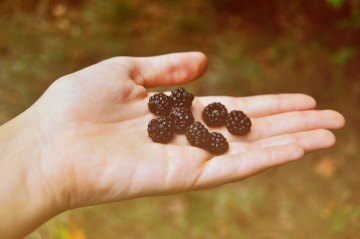
October 4th. Mist and cold, after yesterday’s Indian summer. It was one of the perfect days—the high tide of this present time. I went out for a walk, then picked blackberries on Periton Hill, in that far clump at the edge of the downs. For a long time I sat on the crumbling turf, sheltered from the wind, with the blue distances below, and warm sun lying over this lovely autumn land. And suddenly I was swept out of myself—knowing, knowing, knowing. Feeling the love of God burning through creation, and an ecstasy of bliss pouring through my spirit and down into every nerve. I’m ashamed to put it down in these halting words. For it was ecstasy—that indissoluble mingling of fire and light that the mystics know. There was a scalding sun in my breast—the “kingdom of God within”—that rushed out to that All-Beauty.

patrick-fore-379182-unsplash

Blackberries photo by Yolanda Leyva on Unsplash

Periton Hill photo by Patrick Fore on Unsplash

The universe contrasted with infinite personality

Continuing from Julian of Norwich’s Revelations of Divine Love.

And He showed me more, a little thing, the size of a hazel-nut, on the palm of my hand; it was as round as a ball. I looked thoughtfully and wondered, “What could this be?” And the answer came: “It is all that is made.” I marveled that it continued to exist and did not disintegrate, because it was so small. And I was answered in my understanding: “It exists, both now and forever, because God loves it.” That is, everything owes its very existence to the love of God.

bryan-goff-395922-unsplash

In this Little Thing I saw three truths. The first is that God made it, the second is that God loves it, the third, that God sustains it. But who is this maker, sustainer, and lover I cannot tell; for until I am completely one with Him, I can never be fully at peace or happy: that is to say, not until I am so joined with Him that there is absolutely no created thing between me and my God.

We have got to realize the smallness of all the universe, so that we can see it as nothing compared to God, in order to love and be one with God, Who is uncreated. This is why we don’t feel easy in our hearts and souls: We seek rest in those things that are so trivial they possess no peace at all, and not seeking to know God, who is almighty, all wisdom, all goodness. For He is our true rest. God wants us to know Him, and it pleases him when we rest in Him. Nothing less will satisfy us.


“It is all that is made.”

It may be the most well-known mystical vision in the western world: the entire universe, round as a ball and the size of a hazelnut, being held in the palm of the hand.  Julian of Norwich was born in 1342 and lived as an anchoress–sort of like an extreme nun.  On what seemed to be her deathbed she had a series of 16 visions. She was miraculously healed and spent the years afterward reflecting upon the meaning of the visions. She eventually composed them into a book, Revelations of Divine Love, written in the simple English of the day, not Latin.

That was Middle English, the language of Chaucer. I have used the public domain translation by Grace Warrack and updated the language for modern ears, with the help of Clifton Wolters’ 1966 translation. 

When I was thirty-one, God sent me a bodily sickness, in which I lay three days and three nights. On the fourth night the priest gave me the Last Rites, because those with me were certain that I would not to live till day. But after this I lingered for two more days and nights, and on the third night I was sure I was dying, and those with me were certain too…

My parish priest was sent for to be at my death. By the time he arrived, my eyes were fixed and could not move. I could not speak. He held the Cross before my face and said “I have brought thee the Image of thy Maker and Saviour: look upon it and be strengthened.”….

After this my sight began to fail, and room became dark about me, as if it were night, except in the Image of the Cross which somehow was giving off light; and I could not understand how that was happening. Except for the Cross everything else in the room was horror, as if it were filled with demons. After this the upper part of my body began to die, and I could hardly feel anything, and my breath became shorter and shorter. I was certain I was dying. And in this moment suddenly all my pain was taken from me, and I felt as fit and strong as ever…..

[The visions begin. She has a vision of Jesus dying on the cross, and she receives insight about the Trinity and then Mary, the mother of Jesus. Then this.]

….At this moment our Lord showed me a spiritual sight of how intimately he loves us. I saw that He is everything that we know to be good and helpful. In his love he clothes us, hugs us, holds us tight, because of his tender love, never to leave us. As I saw it he is everything that is good. 

And He showed me more, a little thing, the size of a hazel-nut, on the palm of my hand; it was as round as a ball. I looked thoughtfully and wondered, “What could this be?” And the answer came: “It is all that is made.” I marveled that it continued to exist and did not disintegrate, because it was so small. And I was answered in my understanding: “It exists, both now and forever, because God loves it.” That is, everything owes its very existence to the love of God.

pexels-photo-255527.jpeg

Through Mine Own Eyes, part 3

Concluding installment from Katharine Trevelyan’s remarkable experience in the garden at Coombe.  Previous installments tell more about Ms. Trevelyan. 

annie-spratt-372221-unsplash

Every prayer was fulfilled, every possible desire for the whole world consummated; for His Kingdom had come and I had beheld it with my very eyes. Never again the need to meditate for He was here, to be stood in, sat in, as a child might play on the edges of a great sunny river. And, indeed, I found myself only a child, playing in Him, laughing with Him at the way He was visiting His world. When I stood within Him, He gave and was everything. The years to come, which He showed me as easily as a father shows his child a curious shell beside the great river, held in them no surprise; only wonder and joy.


Through Mine Own Eyes, Part 2

Continuing Katharine Trevelyan’s experience in the garden at Coombe from her “autobiography of a natural mystic.” The book was originally published as A Fool in Love in 1962. Trevelyan came from a prominent British family. Her uncle was the noted historian George Macaulay Trevelyan. She dabbled in anthroposophy (a belief system C. S. Lewis was well acquainted with because of his life-long friendship and debate with Owen Barfield). Before the 1958 experiences recounted in these installments, Trevelyan had joined the Church of Christ but had become disenchanted with its divisions.  This is the second of three installments. 

Screen Shot 2018-04-23 at 12.43.55 PM

Every flower spoke to me, every spider wove a miracle of intricacy for my eyes, every bird understood that here was heaven come to earth. Turner must have been seeing the skies as I saw them then—living cloud shapes crossing and recrossing each other as though conversing inform or singing in color.

But there was something more wonderful than the Light within the light – more wonderful than the standstill of time. It was that God walked with me in the garden as He did before the Fall. Whether I sat, whether I walked, He was there – radiant, burningly pure, holy beyond holy.

When I breathed, I breathed Him; when I asked a question, He both asked and answered it.

My heart was unshuttered to Him, and He came and went at will; my head had no limit or boundary of skull, but the Spirit of God played on me as though my mind were a harp which reached the zenith.

sora-sagano-449514-unsplashPhoto by Sora Sagano on Unsplash

The Third Glimpse

Lewis completes this part of his memoir. Note again the role of literature in this mystical experience–but also that its role is tangential, almost accidental.  We can speculate that the piercing juxtaposition of “the beautiful” with “is dead” foreshadowed Lewis’s acceptance of Absolute Goodness himself dying on a cross—just as the snippet from Tegner’s Drapa represents all the pagan myths showing the longing for the death of someone so good to be meaningful, redemptive.  Be that as it may, one reason Lewis belongs here at the beginning of this blog is that his ability to both describe the indescribable and reflect upon its nature may be unsurpassed. Note that this Joy was a beacon throughout his life: “in a sense the central story of my life is about nothing else.” (Same for me.)

Balder
Baldur the beautiful is dead

The third glimpse came through poetry. I had become fond of Longfellow’s Saga of King Olaf: fond of it in a casual, shallow way for its story and its vigorous rhythms. But then, and quite different from such pleasures, and like a voice from far more distant regions, there came a moment when I idly turned the pages of the book and found the unrhymed translation of Tegner’s Drapa and read

I heard a voice that cried,
Balder the beautiful
Is dead, is dead—-

I knew nothing about Balder; but instantly I was uplifted into huge regions of northern sky, I desired with almost sickening intensity something never to be described (except that it is cold, spacious, severe, pale, and remote) and then, as in the other examples, found myself at the very same moment already falling out of that desire and wishing I were back in it.

Mountain sky fabrizio-conti-559920-unsplash

The reader who finds these three episodes of no interest need read this book no further, for in a sense the central story of my life is about nothing else. For those who are still disposed to proceed I will only underline the quality common to the three experiences; it is that of an unsatisfied desire which is itself more desirable than any other satisfaction. I call it Joy, which is here a technical term and must be sharply distinguished both from Happiness and from Pleasure. Joy (in my sense) has indeed one characteristic, and one only, in common with them; the fact that anyone who has experienced it will want it again. Apart from that, and considered only in its quality, it might almost equally well be called a particular kind of unhappiness or grief. But then it is a kind we want. I doubt whether anyone who has tasted it would ever, if both were in his power, exchange it for all the pleasures in the world. But then Joy is never in our power and pleasure often is.
-C. S. Lewis, Surprised by Joy. New York: Harcourt, Brace & Co., 1955. @ C. S. Lewis Pte. Ltd.

For more on C. S. Lewis see  Into the Wardrobe as well as “The official” website.

See also Fellowship of the Performing Arts for their wonderful dramatizations of Lewis’s life and works.