Across the Chasm–Underwater

Featured
Photo by Alex Rose on Unsplash

I thought the previous installment from C. S. Lewis’s The Pilgrim’s Regress would be the last from that book, but now I’ve decided to not leave the book on such a stark and ugly note. Or such ugly pics, for that matter.

In that post, John faced Death–literally. Death told him that death to self is inevitable: He can go willingly or he can struggle. He chooses to go willingly.

He finds himself on the floor of the canyon. A small crowd of people are standing around a figure sitting on a throne: Mother Kirk (the mother church). A large pool stretches between them and the opposite wall of the canyon. His old companion Vertue is there too, sitting on the ground completely naked. John’s long quest has reached its climax.

Mother Kirk tells them that the only way to the other side is to become naked like Vertue and dive into the water headfirst. Then they must swim downwards to a tunnel in the wall that leads up and onto the opposite side. John thinks to himself, “I see they have brought me here to kill me.”

As he hesitates on the brink, he is visited by wraiths of all the men representing worldviews he met heretofore, such as Old Enlightenment, Sensible, and Humanist, who all try to tempt him away from believing in the necessity or even the reality of what he is about to do (baptism and rebirth). But Vertue interrupts his ruminations: “Come on, John…the longer we look at it the less we shall like it,” and he dives into the water. John soon follows.

From The Pilgrim’s Regress by C. S. Lewis, Book 9, Chapter V: Across the Canyon

My dream grew darker so that I have a sense, but little clear memory of the things that John experienced both in the pool and in great catacombs, paved sometimes with water, sometimes with stone, and upon winding stairways in the live rocks whereby he and Vertue ascended through the inwards of the mountain to the land beyond Peccatum Adae.* He learned many mysteries in the earth and passed through many elements, dying many deaths….

Of all the people he had met in his journey only Wisdom appeared to him in the caverns, and troubled him by saying that no man could really come where he had come. All his adventures were but figurative, for no professed experience of these places could be anything other than mythology. But then another voice spoke to him from behind him, saying:

“Child, if you will, it is mythology. It is but truth, not fact: an image, not the very real. But then it is My mythology. The words of Wisdom** are also myth and metaphor: but since they do not know themselves for what they are, in them the hidden myth is master, where it should be servant: and it is but of man’s inventing.

“But this is My inventing, this is the veil under which I have chosen to appear even from the first until now. For this end I made your senses and for this end your imagination, that you might see My face and live.

“What would you have? Have you not heard among the Pagans the story of Semele? Or was there any age in any land when men did not know that corn and wine were the blood and body of a dying and yet living God?”

Photo by geoff trodd on Unsplash

Afterword

This passage is unique in the book for it is the only time God Himself speaks. The voice seeks to set John’s heart at ease and counter what Wisdom said about the relation of truth and myth.

In this, his first book that was not poetry and his first apologetic, Lewis certainly had in mind the theories of The Golden Bough by Sir James George Frazer, an enormously influential series of books first published in 1890. It argued that myths of a god whose death and resurrection enabled the crops to grow–or were the crops growing–were nearly universal across cultures, and the story of Jesus was merely one of these.

What John is experiencing as he dives and goes underwater is of course baptism: death to the old self, the rising of the new. Wisdom has said this could only be metaphorical, not a real experience. But God counters that use of the word “only” and explains that it is both mythical and real, it is His means by which finite, sinful people will be able to live with a holy God, “that you might see My face and live.”

Lewis and Literary Theory

Lewis responds to Frazer’s anthropology by applying knowledge from his own areas of expertise: literary and linguistic theory and clarifying the relationship between myth, fact and revelation. “It is but truth, not fact” is a concept seeded into Lewis by his friend, J.R.R. Tolkien, during the famous chat they had on Oxford grounds which led to Lewis’s conversion. The seed Tolkien planted bloomed also into an essay Lewis later wrote, “Myth Became Fact.” It provides a distinction between myth and legend, myth and truth, myth and factuality. It describes myth in a way that no other literary analyst, as far as I know, had done. Lewis says myths are not merely legends, much less allegories, or even untrue. He says that myths allow us to experience, to “taste,” an archetypal truth that gives rise to many truths.

Photo by NEOM on Unsplash

Lewis and Tolkien (and G.K. Chesterton as well) believed that God prepared the way for Jesus Christ through the Jews by law and prophecy and through the pagans by imagination. Stories of a dying but living god seized the pagan sensibility. There are myths that humans invent and then there is the one that God invented: All life does come only from plants that die in winter only to rise again. All plants really do provide a seed that dies yet creates a much bigger life.

Jesus himself seems to acknowledge these pagan ideas when he answers the request from the Greeks in John 12:20-25: Predicting his own death, he continues, “Very truly I tell you, unless a kernel of wheat falls to the ground and dies, it remains only a single seed. But if it dies, it produces many seeds.”

The voice of God here says that Wisdom’s words also consist of “myth and metaphor” but Wisdom is unaware that they do. This idea that literal language was not distinctly different or free from figurative language was first advanced by Giambattista Vico (1668–1744) and radicalized by Friedrich Nietzsche (1844–1900). But no modern literary theorists advanced it until I.A. Richards in 1936. It became a central tenet to the deconstruction theories of Jacque Derrida and Paul deMan much later in the 20th century. That Lewis was arguing it in 1933 shows he was ahead of his time.

Whither Mysticism?

What has all this to do with mystical wonder? This passage illustrates an intellectual dimension of mystical wonder. It portrays the astounding way God reaches us through all we experience as meaning. The One revealed as The Word is the essence of meaningfulness. When we want to open a door to a transcendent dimension we use myth and metaphor. When God wants to, He uses human lives.

*Latin: the sin of Adam

How to Find What You Have Always Wanted

Continuing from the previous installment and the vision of the 17th-century Moravian educator and bishop John Amos Komensky. Recall that shortly before these mystical experiences Komensky lost his wife and children while fleeing war. We can be sure that, as Frank Laubach expressed it, Komensky had “the heart of his heart cut by suffering.”  This passage continues his vision of Jesus Christ.

…Then He, seeing me overwhelmed with joy, spoke further to me: “Where, then, have you been, my son? Why have you tarried so long?  By what path have you come? What have you sought in the world? Joy! Where could you see it but in God; 

pics-of-jesus-hd-images-backgrounds-christs-mobile

and where could you seek God, but in His own temple, and what is the temple of the living God, but the living temple that He Himself has fashioned—your own heart? I saw, my son, that you went astray, but I want to see it no longer. I have brought you to your own self. I have led you into yourself. For here have I chosen my palace and my dwelling. If you want to dwell with me here, you will find here what you have vainly sought on earth:  rest, comfort, glory, and abundance of all things. This I promise you, my son, that you will not be deceived here as you were there in the world.” 

Christ’s words to Komensky confirm a concept often repeated in the New Testament letters, “Christ in you” (e.g., Col. 1:17). And it confirms many Old Testament verses too. That is because it may well be said that the entire aim of God as recounted in the Bible is to once again bring human beings into fellowship with Himself as it wasand perhaps even better than it wasbefore the Fall. 

As with many of our selections this one is taken from The Protestant Mystics, selected and edited by Anne Fremantle, with an introduction by W. H. Auden. Boston: Little, Brown and Co., 1964. I have modernized some of the syntax and vocabulary for contemporary readers.

Six-winged Angels of Fire

Sorry for the delay; I’ve been traveling and far too busy lately. We return to mystical experiences of the Old Testament. After Jesus, probably the most important and poetic of all the Biblical prophets is Isaiah. But, apparently, he was not always so willing or gifted. This is the famous story of his calling to a new life. It’s a prime example of several elements: 1) the fear that acknowledges God’s holiness, 2) God’s quick forgiveness that follows this recognition, and 3) the resulting eagerness to do God’s will.  And if that process reminds you of the New Testament gospel’s effect, it is no accident. 

Isaiah, chapter 6

The year King Uzziah died I saw the Lord! He was sitting on a lofty throne, and the Temple was filled with his glory. Hovering about him were mighty, six-winged angels of fire. With two of their wings they covered their faces, with two others they covered their feet, and with two they flew. In a great antiphonal chorus they sang, “Holy, holy, holy is the Lord Almighty; the whole earth is filled with his glory.” Such singing it was! It shook the Temple to its foundations, and suddenly the entire sanctuary was filled with smoke.

Then I said, “My doom is sealed, for I am a foul-mouthed sinner, a member of a sinful, foul-mouthed race; and I have looked upon the King, the Lord of heaven’s armies.”

Then one of the mighty angels flew over to the altar and with a pair of tongs picked out a burning coal. He touched my lips with it and said, “Now you are pronounced ‘not guilty’ because this coal has touched your lips. Your sins are all forgiven.”

Then I heard the Lord asking, “Whom shall I send as a messenger to my people? Who will go?”

And I said, “Lord, I’ll go! Send me.”

–Translated from Hebrew to English in The Message, Eugene Peterson.

“…this direct first hand grasping of God Himself…”

Frank LaubachContinuing with the letters of Frank Laubach.  See previous post for information on Laubach. 

March 15, 1930

This week a new, and to me marvelous experience, has come out of my loneliness. I have been so desperately lonesome that it was unbearable save by talking with God. And so every waking moment of the week I have been looking toward him, with perhaps the exception of an hour or two. 

Last Thursday night I was listening to a phonograph in Lumbatan and allowing my heart to commune when something broke within me, and I longed to lift my own will up and give it completely to God. 

How infinitely richer this direct first hand grasping of God Himself is, than the old method which I used and recommended for years, the reading of endless devotional books. Almost it seems to me now that the very Bible cannot be read as a substitute for meeting God soul to soul and face to face. And yet, how was this new closeness achieved? Ah, I know now that it was by cutting the very heart of my heart and by suffering. Somebody was telling me this week that nobody can make a violin speak 

alex-blajan-199244-unsplashthe last depths of human longing until that soul has been made tender by some great anguish. I do not say it is the only way to the heart of God, but must witness that it has opened an inner shrine for me which I never entered before. 

Photo by Alex Blăjan on Unsplash

“Their mind is changed and passes into lasting melody”

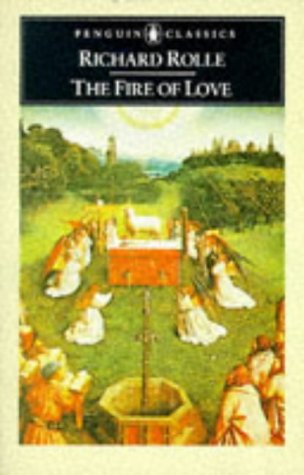
Another entry from Richard Rolle’s 14th century Christian classic, The Fire of Love.  A glimpse of the afterlife. There is no greater image of heavenly joy and flourishing than music. 

The Fire of Love, chapter 5

Therefore all those who are filled with love and joy, the seekers after inextinguishable heat, unite to sing in one glorious choir of rich melody; and now this company of friends has the shade of heaven to protect them against the scorching of lustful flattery and ill will. The very fervour of their sweet love ravishes them with the sight of their Beloved. Flowering through this loving flame into all virtue they rejoice in their Maker. Their mind is changed and passes into lasting melody. From now on their meditations become song. Melancholy has been driven out of the mansion of their spirit, and it now resounds with wondrous melody. The one-time torment of their soul has vanished, and now in glowing health they dwell in the heights of harmony, in the wonderful rhythm of sweet and melodious meditation. 

–Translation and copyright 1972 by Clifton Wolters. Penguin Classics.

Joyful Heat

What the 14th-century mystic Richard Rolle has to say is not merely inspiring but challenging.  In it we find the same axis that is throughout the Bible, the unyielding fact that you cannot love both the world and God.  At least not very well.  Like me, you may find yourself busy with both but getting the best of neither relationship. 

Of late there has been a refreshing current in Christian thought, a return to the doctrine of creation and God’s judgment “it is good.” But the hard words remain: “Do not love the world or the things in the world. If anyone loves the world, the love of the Father is not in him. For all that is in the world—the desires of the flesh and the desires of the eyes and pride of life—is not from the Father but is from the world. The world and its desires pass away, but whoever does the will of God lives forever” (I John 2:15-17). “Don’t you realize that friendship with the world makes you an enemy of God?” (James 4:4).  “You cannot serve both God and Mammon [money]” (Matthew 6:24). In our current, unprecedented material prosperity, it is well to remember these verses and the teachings of Richard Rolle.

For a 14th century man much is known about Richard Rolle. All I will say here is that he was a student at Oxford when a Master’s degree was a seven-year program, but he abandoned his studies. He stole two cloaks from his father and ran away from home to be a monk. Theft! An inauspicious start to a holy life, as many have noted. 

The Fire of Love

Further, perfect souls who have been caught up into this friendship–surpassing, abundant, and eternal!–discover that life is suffused with imperishable sweetness from the glittering chalice of sweet charity.* In holy happy wisdom they inhale joyful heat into their souls, and as a result are much cheered by the indescribable comfort of God’s healing medicine. Here at all events is refreshment for those who love their high and eternal heritage, even though in their earthly exile distress befell them. However, they think it not unfitting to endure a few year’s hardship in order to be raised to heavenly thrones, and never leave the. They have been selected out of all mankind to be the beloved of their Maker and to be crowned with glory, since, like the seraphim in highest heaven, they have been inflamed with the same love. Physically they may have sat in solitary state, but in mind they have companied with angels, and have yearned for their Beloved. Now they sing most sweetly a prayer of love everlasting as they rejoice in Jesus:

Oh honeyed flame, sweeter than all sweet, delightful beyond all creation!

My God, my Love, surge over me, pierce me by your love, wound me with your beauty. 

Surge over me, I say, who am longing for your comfort. 

Reveal your healing medicine to your poor lover. 

See, my one desire is for you; it is you my heart is seeking.

My soul pants for you; my whole being is athirst for you. 

–From chapter 2 in The Fire of Love by Richard Rolle. Translation and copyright 1972 by Clifton Wolters. Penguin Classics.

*Not today’s common usage of “charity” but from caritas (Greek agape), which means the type of love that is unconditional, giving, self-sacrificing, divine.


Someone to Meet in the Next World

One of the most astonishing accounts in modern times is Dr. Eben Alexander’s Proof of Heaven.  It made a splash when published in 2012, because this was a near-death experience (NDE) unlike any other.  Beforehand, Alexander was a skeptic about the after-life and about NDEs.  He was an unsentimental and successful neurosurgeon who believed, like many in the medical community, that NDEs were hallucinations created by neuro-transmitters continuing to fire in the brain when consciousness ceased.  But his own illness seemed specifically designed to undermine that theory.  He was suddenly overcome by a rare meningitis that not only placed him in a coma but shut down his brain.  All the specialists involved told his family that if he ever recovered from his coma he would be a vegetable.  After a week they were just about to “pull the plug” when he opened his eyes and began talking.  He was completely cured and no one could understand how.  But we might understand the why.  I have not finished the book yet much less rendered a decision on how kosher its theology is.  But Alexander’s life since then reminds me of Mark Helprin’s epigram to Winter’s Tale:

I have been to another world, and come back. Listen to me. 

Near the beginning of his experience, Alexander finds himself flying without an aircraft over a paradisical land. Assuming it is true and not a hallucination it reminds us that mystic wonder has more to do with people than place.  And it gives a rock solid glimpse of what “higher and holier” means. 

Proof of Heaven

Someone was next to me: a beautiful girl with high cheekbones and deep blue eyes.  She was wearing the same kind of peasant-like clothes that the people in the village down below wore. Golden-brown tresses framed her lovely face….

The girl’s outfit was simple, but its colors–powder blue, indigo, and pastel orange-peach–had the same overwhelming, super-vivid aliveness that everything else in the surroundings had.  She looked at me with a look that, if you saw it for a few moments, would make your whole life up to that point worth living, no matter what had happened in it is so far.  It was not a romantic look.  It was not a look of friendship. It was a look that was somehow beyond all these…beyond all the different types of love we have down here on earth.  It was something higher, holding all those other kinds of love within itself while at the same time being more genuine and pure than all of them.

In the end of the book, Dr. Alexander, who was adopted as a baby, is given an old photo and discovers this girl is his birth-sister whom he never knew.

See it on Amazon

Proof of Heaven: A Neurosurgeon’s Journey to the Afterlife, by Dr Eben Alexander.  New York: Simon & Schuster, 2012.  Copyright 2012 by Dr. Eben Alexander.  All rights reserved.

Exodus 19: The Deadly Presence of Holiness

This is the type of mystical experience that leaves us in fear and trembling. This passage is the Grandaddy of that type.

mount-sinai-egypt-moses-1244104-wallpaperIn the middle of the desert a lone mountain rises up.  It is called Sinai. The Israelites camp at the base, and Moses climbs up. Somewhere along the way, God calls from the mountain. God tells Moses to remind the people below how God rescued them from the Egyptians to “be my own little flock….a kingdom of priests to God, a holy nation.”  The context is important. God appears with fire and thunder in the passage below, and then he gives to Moses the commandments for creating that reverent and just society: a holy nation. 
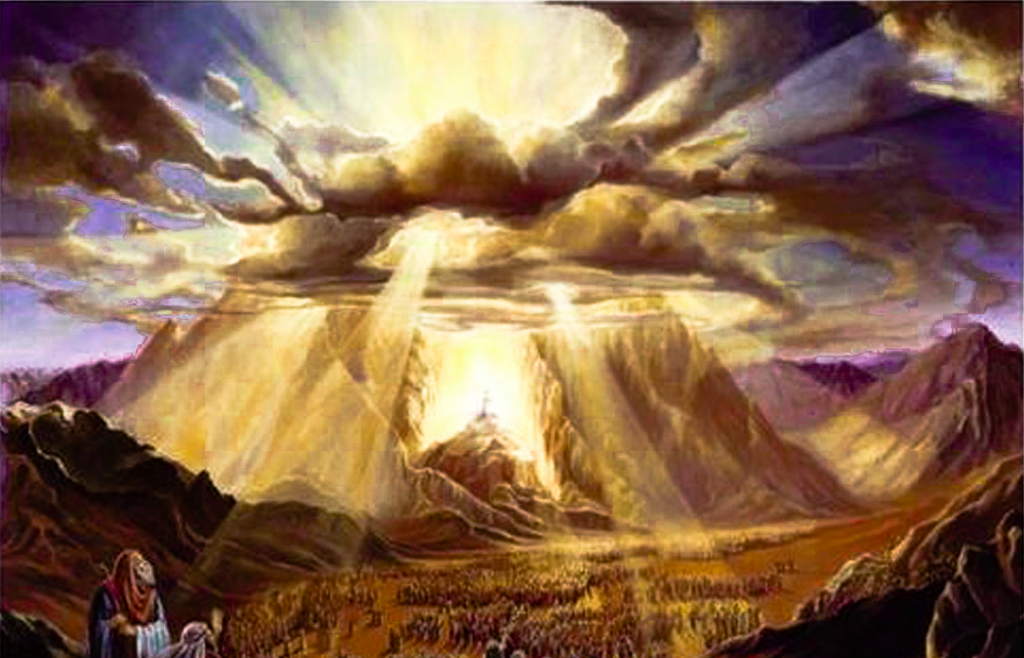
God appears once again without disguise, even the disguise of a burning bush.  This aspect of holiness that we see in Exodus 19 is unpopular or unknown these days, even despised–even among Christians, Jews, and Muslims, sometimes.  To believe someone is so different from us, so set apart (one of the meanings of “holy”), so much better than we are, may defy our democratic principles. It certainly hurts our egos.Exodus-19-21-1024x658

But unless we understand this aspect, we cannot understand how infinitely morally good God is compared to us. But when we do understand it, we also get a glimpse of how much love and humility is poured out in the life and death of Jesus Christ.  We understand why we need Jesus, why he is “the way, the truth, and the life,” the end as well as the means. We understand that only a man who was God, and a God who would become a man, could bridge that awe–full gap between us and God. 

Exodus 19

Moses returned from the mountain and called together the leaders of the people and told them what the Lord had said.

They all responded in unison, “We will certainly do everything he asks of us.” Moses reported the words of the people to the Lord.

Then [God] said to Moses, “I am going to come to you in the form of a dark cloud, so that the people themselves can hear me when I talk with you, and then they will always believe you. Go down now and see that the people are ready for my visit. Sanctify them today and tomorrow, and have them wash their clothes.  Then, the day after tomorrow, I will come down upon Mount Sinai as all the people watch.  Set boundary lines the people may not pass, and tell them, ‘Beware! Do not go up into the mountain or even touch its boundaries; whoever does shall die— no hand shall touch him, but he shall be stoned or shot to death with arrows, whether man or animal.’ Stay away from the mountain entirely until you hear a ram’s horn sounding one long blast; then gather at the foot of the mountain!”

So Moses went down to the people and sanctified them and they washed their clothing.

He told them, “Get ready for God’s appearance two days from now, and do not have sexual intercourse with your wives.”img_5635

On the morning of the third day there was a terrific thunder and lightning storm, and a huge cloud came down upon the mountain, and there was a long, loud blast as from a ram’s horn; and all the people trembled.  Moses led them out from the camp to meet God, and they stood at the foot of the mountain.  All Mount Sinai was covered with smoke because Jehovah descended upon it in the form of fire; the smoke billowed into the sky as from a furnace, and the whole mountain shook with a violent earthquake.  As the trumpet blast grew louder and louder, Moses spoke and God thundered his reply.  So the Lord came down upon the top of Mount Sinai and called Moses up to the top of the mountain, and Moses ascended to God.

But the Lord told Moses, “Go back down and warn the people not to cross the boundaries. They must not come up here to try to see God, for if they do, many of them will die. Even the priests on duty[a] must sanctify themselves, or else I will destroy them.”

God Arrives without Angel Disguise

We continue with mystical experiences of the Bible.  After the Fall in Genesis 3 and the calling of Abraham in Genesis 12 this may be the most important hinge in the Old Testament.  God tells Moses that he is the man to defy Pharaoh and lead hundreds of thousands of Israelites out of their slavery in Egypt.  Moses’ response of course is “Not me! I am not the person for such a job!”

burning-bush-exodus-moses

What we see in the Exodus passages are people meeting the awesome strangeness and other-ness of God—an experience of the Numinous, as Rudolf Otto described it.  In Genesis after the Fall, God shows up only in disguise, so to speak: as a voice, as angels, as a vision while asleep. In Exodus the mission is apparently so critical that he shows up without disguise. There is so much at stake: His people must know who He is; hundreds of thousands of them must walk out of Egypt not only unscathed but rich; Pharaoh’s gods and magicians must be publicly defeated; the people must never forget this God is their rescuer and redeemer who can do absolutely anything; a new nation with unprecedented laws of justice, mercy, and reverence must begin, a way of life that God intends to spread over the earth and end evil forever. 

But God coming without disguise creates a confrontation with absolute holiness.  God is love, but God is also absolute goodness, and in His presence we do not need to be told that we are very much not.  Moses hides his face.  For the same reason, centuries later, Peter will tell Jesus, “Go away from me, for I am sinful man.”  

This is also the momentous time when God reveals his true, personal name, not a title. Often transliterated from the Hebrew as YHWH, it is mysterious and so is its pronunciation.  But it seems to mean “I Am Who I Am,” that is, the self-subsistent one; the only one that cannot be compared to or depend upon anything else. 

Exodus 3: God, The Fire that Never Goes Out, Speaks to Moses

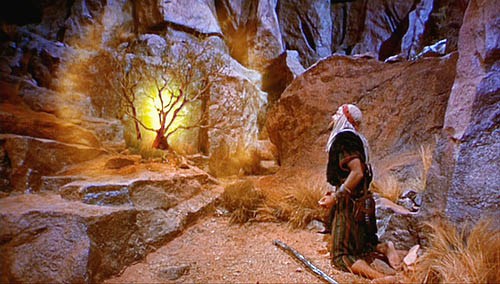
Moses was shepherding the flock of Jethro, his father-in-law, the priest of Midian. He led the flock to the west end of the wilderness and came to the mountain of God, Horeb. The angel of God appeared to him in flames of fire blazing out of the middle of a bush. He looked. The bush was blazing away but it didn’t burn up.

Moses said, “What’s going on here? I can’t believe this! Amazing! Why doesn’t the bush burn up?”

God saw that he had stopped to look. God called to him from out of the bush, “Moses! Moses!”

He said, “Yes? I’m right here!”

God said, “Don’t come any closer. Remove your sandals from your feet. You’re standing on holy ground.”

Then he said, “I am the God of your father: The God of Abraham, the God of Isaac, the God of Jacob.”

Moses hid his face, afraid to look at God.

God said, “I’ve taken a good, long look at the affliction of my people in Egypt. I’ve heard their cries for deliverance from their slave masters; I know all about their pain. And now I have come down to help them, pry them loose from the grip of Egypt, get them out of that country and bring them to a good land with wide-open spaces, a land lush with milk and honey….


Burning bush

Then Moses said to God, “Suppose I go to the People of Israel and I tell them, ‘The God of your fathers sent me to you’; and they ask me, ‘What is his name?’ What do I tell them?”

God said to Moses, “I-AM-WHO-I-AM. Tell the People of Israel, ‘I-AM sent me to you.’”

God continued with Moses: “This is what you’re to say to the Israelites: ‘God, the God of your fathers, the God of Abraham, the God of Isaac, and the God of Jacob sent me to you.’ This has always been my name, and this is how I always will be known.

–Exodus 3:1 – 8a; 13-15, The Message


A Prison, a Paradise: part 2

Continuing yesterday’s installment from A Prison, A Paradise. After her near-suicide, Gay Taylor writes:

…when I came back from Tripoly, the peace of God seemed to enter my heart. I feel that it all had to happen, and happen in just that way. Nothing else would have removed the suicide-obsession I’ve cherished secretly, ever since I was a child. Those hours by the northern river had to be, when I was beyond all human help, and knew at last that God was there.  


yolanda-leyva-635145-unsplash

October 4th. Mist and cold, after yesterday’s Indian summer. It was one of the perfect days—the high tide of this present time. I went out for a walk, then picked blackberries on Periton Hill, in that far clump at the edge of the downs. For a long time I sat on the crumbling turf, sheltered from the wind, with the blue distances below, and warm sun lying over this lovely autumn land. And suddenly I was swept out of myself—knowing, knowing, knowing. Feeling the love of God burning through creation, and an ecstasy of bliss pouring through my spirit and down into every nerve. I’m ashamed to put it down in these halting words. For it was ecstasy—that indissoluble mingling of fire and light that the mystics know. There was a scalding sun in my breast—the “kingdom of God within”—that rushed out to that All-Beauty.

patrick-fore-379182-unsplash

Blackberries photo by Yolanda Leyva on Unsplash

Periton Hill photo by Patrick Fore on Unsplash