Across the Chasm–Underwater

Featured
Photo by Alex Rose on Unsplash

I thought the previous installment from C. S. Lewis’s The Pilgrim’s Regress would be the last from that book, but now I’ve decided to not leave the book on such a stark and ugly note. Or such ugly pics, for that matter.

In that post, John faced Death–literally. Death told him that death to self is inevitable: He can go willingly or he can struggle. He chooses to go willingly.

He finds himself on the floor of the canyon. A small crowd of people are standing around a figure sitting on a throne: Mother Kirk (the mother church). A large pool stretches between them and the opposite wall of the canyon. His old companion Vertue is there too, sitting on the ground completely naked. John’s long quest has reached its climax.

Mother Kirk tells them that the only way to the other side is to become naked like Vertue and dive into the water headfirst. Then they must swim downwards to a tunnel in the wall that leads up and onto the opposite side. John thinks to himself, “I see they have brought me here to kill me.”

As he hesitates on the brink, he is visited by wraiths of all the men representing worldviews he met heretofore, such as Old Enlightenment, Sensible, and Humanist, who all try to tempt him away from believing in the necessity or even the reality of what he is about to do (baptism and rebirth). But Vertue interrupts his ruminations: “Come on, John…the longer we look at it the less we shall like it,” and he dives into the water. John soon follows.

From The Pilgrim’s Regress by C. S. Lewis, Book 9, Chapter V: Across the Canyon

My dream grew darker so that I have a sense, but little clear memory of the things that John experienced both in the pool and in great catacombs, paved sometimes with water, sometimes with stone, and upon winding stairways in the live rocks whereby he and Vertue ascended through the inwards of the mountain to the land beyond Peccatum Adae.* He learned many mysteries in the earth and passed through many elements, dying many deaths….

Of all the people he had met in his journey only Wisdom appeared to him in the caverns, and troubled him by saying that no man could really come where he had come. All his adventures were but figurative, for no professed experience of these places could be anything other than mythology. But then another voice spoke to him from behind him, saying:

“Child, if you will, it is mythology. It is but truth, not fact: an image, not the very real. But then it is My mythology. The words of Wisdom** are also myth and metaphor: but since they do not know themselves for what they are, in them the hidden myth is master, where it should be servant: and it is but of man’s inventing.

“But this is My inventing, this is the veil under which I have chosen to appear even from the first until now. For this end I made your senses and for this end your imagination, that you might see My face and live.

“What would you have? Have you not heard among the Pagans the story of Semele? Or was there any age in any land when men did not know that corn and wine were the blood and body of a dying and yet living God?”

Photo by geoff trodd on Unsplash

Afterword

This passage is unique in the book for it is the only time God Himself speaks. The voice seeks to set John’s heart at ease and counter what Wisdom said about the relation of truth and myth.

In this, his first book that was not poetry and his first apologetic, Lewis certainly had in mind the theories of The Golden Bough by Sir James George Frazer, an enormously influential series of books first published in 1890. It argued that myths of a god whose death and resurrection enabled the crops to grow–or were the crops growing–were nearly universal across cultures, and the story of Jesus was merely one of these.

What John is experiencing as he dives and goes underwater is of course baptism: death to the old self, the rising of the new. Wisdom has said this could only be metaphorical, not a real experience. But God counters that use of the word “only” and explains that it is both mythical and real, it is His means by which finite, sinful people will be able to live with a holy God, “that you might see My face and live.”

Lewis and Literary Theory

Lewis responds to Frazer’s anthropology by applying knowledge from his own areas of expertise: literary and linguistic theory and clarifying the relationship between myth, fact and revelation. “It is but truth, not fact” is a concept seeded into Lewis by his friend, J.R.R. Tolkien, during the famous chat they had on Oxford grounds which led to Lewis’s conversion. The seed Tolkien planted bloomed also into an essay Lewis later wrote, “Myth Became Fact.” It provides a distinction between myth and legend, myth and truth, myth and factuality. It describes myth in a way that no other literary analyst, as far as I know, had done. Lewis says myths are not merely legends, much less allegories, or even untrue. He says that myths allow us to experience, to “taste,” an archetypal truth that gives rise to many truths.

Photo by NEOM on Unsplash

Lewis and Tolkien (and G.K. Chesterton as well) believed that God prepared the way for Jesus Christ through the Jews by law and prophecy and through the pagans by imagination. Stories of a dying but living god seized the pagan sensibility. There are myths that humans invent and then there is the one that God invented: All life does come only from plants that die in winter only to rise again. All plants really do provide a seed that dies yet creates a much bigger life.

Jesus himself seems to acknowledge these pagan ideas when he answers the request from the Greeks in John 12:20-25: Predicting his own death, he continues, “Very truly I tell you, unless a kernel of wheat falls to the ground and dies, it remains only a single seed. But if it dies, it produces many seeds.”

The voice of God here says that Wisdom’s words also consist of “myth and metaphor” but Wisdom is unaware that they do. This idea that literal language was not distinctly different or free from figurative language was first advanced by Giambattista Vico (1668–1744) and radicalized by Friedrich Nietzsche (1844–1900). But no modern literary theorists advanced it until I.A. Richards in 1936. It became a central tenet to the deconstruction theories of Jacque Derrida and Paul deMan much later in the 20th century. That Lewis was arguing it in 1933 shows he was ahead of his time.

Whither Mysticism?

What has all this to do with mystical wonder? This passage illustrates an intellectual dimension of mystical wonder. It portrays the astounding way God reaches us through all we experience as meaning. The One revealed as The Word is the essence of meaningfulness. When we want to open a door to a transcendent dimension we use myth and metaphor. When God wants to, He uses human lives.

*Latin: the sin of Adam

Infinite Love says: “Pull up a chair. Join me. Let’s dig in.”

George HerbertGeorge Herbert was a vicar in the Church of England as well as one of the most beloved poets of the 17th century. The monasteries on England were no more, but it is clear that neither all-out devotion to God nor mystical experience had disappeared. Herbert wrote many poems expressing a deep, affective devotion and an imagination awakened to God’s infinite love as found in Jesus.

The following poem is one of his best.  It assumes knowledge of the New Testament’s simple teaching, “God is love.”  With connotations of the communion rite, it describes our hesitancy to accept the grace of God. “Can I really join You, be with You, without becoming perfect first, without having earned the right?”

The poem had a momentous effect on the 20th century philosopher and social activist  Simone Weil, as we will see in the next installment.

Love III

Love bade me welcome. Yet my soul drew back
                             Guilty of dust and sin.
But quick-eyed Love, observing me grow slack
                             From my first entrance in,
Drew nearer to me, sweetly questioning,
                             If I lacked any thing.

“A guest,” I answered, “worthy to be here:”
                             Love said, “You shall be he.”
“I the unkind, ungrateful? Ah my dear,
                             I cannot look on thee.”
Love took my hand, and smiling did reply,
                             “Who made the eyes but I?”

“Truth Lord, but I have marred them: let my shame
                             Go where it doth deserve.”
“And know you not,” says Love, “who bore the blame?”
                             “My dear, then I will serve”
“You must sit down,” says Love, “and taste my meat:”
                             So  I did sit and eat.

Quotation marks added to clarify who's speaking. 

“Whatever struggles you have, transfer them to Me”

Sorry, fans, for the longest delay ever!  Travels, new jobs, new schools, hurricanes, bees, sin.

Another from our series by John Amos Komensky. The pilgrim responds to Jesus’ welcoming words. He tells Jesus he will do whatever Jesus asks, to be nothing, so that Jesus will be everything.

Chapter 39

Their Betrothal

Jesus replies,

I accept this from you, my son.  Hold to this, become, call yourself, and remain my own. Mine, indeed, you were and are from all eternity, but you did not know it. I have long prepared for you that happiness to which I will now lead you; but you did not understand what I was doing. I have led you to yourself through strange paths and by round-about ways; you did not know this, nor what I, the ruler of all my chosen ones, intended. Neither did you perceive by what means I worked on you. But I was everywhere with you, and therefore somewhat guided you through these crooked paths, that I might at last bring you even closer to me.  Neither the world, your guides, nor even Solomon could teach you. There is no way that they could enrich you, content you, satisfy the desires of your heart, because they didn’t have what you were searching for. But I will teach you everything, enrich you, and content you.

“This only I demand of you: that whatever you have seen in the world, and whatever struggles you have witnessed among people, you should transfer it to me, and lay the burden of it on me. This as long as you live, shall be your work and your task; of that which men seek there in the world, but don’t find—that is, peace and joy—I will give you in abundance.”

From Komensky’s The Labyrinth of the World.  As with many of our selections this one is taken from The Protestant Mystics, selected and edited by Anne Fremantle, with an introduction by W. H. Auden. Boston: Little, Brown and Co., 1964. I have modernized some of the syntax and vocabulary for contemporary readers.

How to Find What You Have Always Wanted

Continuing from the previous installment and the vision of the 17th-century Moravian educator and bishop John Amos Komensky. Recall that shortly before these mystical experiences Komensky lost his wife and children while fleeing war. We can be sure that, as Frank Laubach expressed it, Komensky had “the heart of his heart cut by suffering.”  This passage continues his vision of Jesus Christ.

…Then He, seeing me overwhelmed with joy, spoke further to me: “Where, then, have you been, my son? Why have you tarried so long?  By what path have you come? What have you sought in the world? Joy! Where could you see it but in God; 

pics-of-jesus-hd-images-backgrounds-christs-mobile

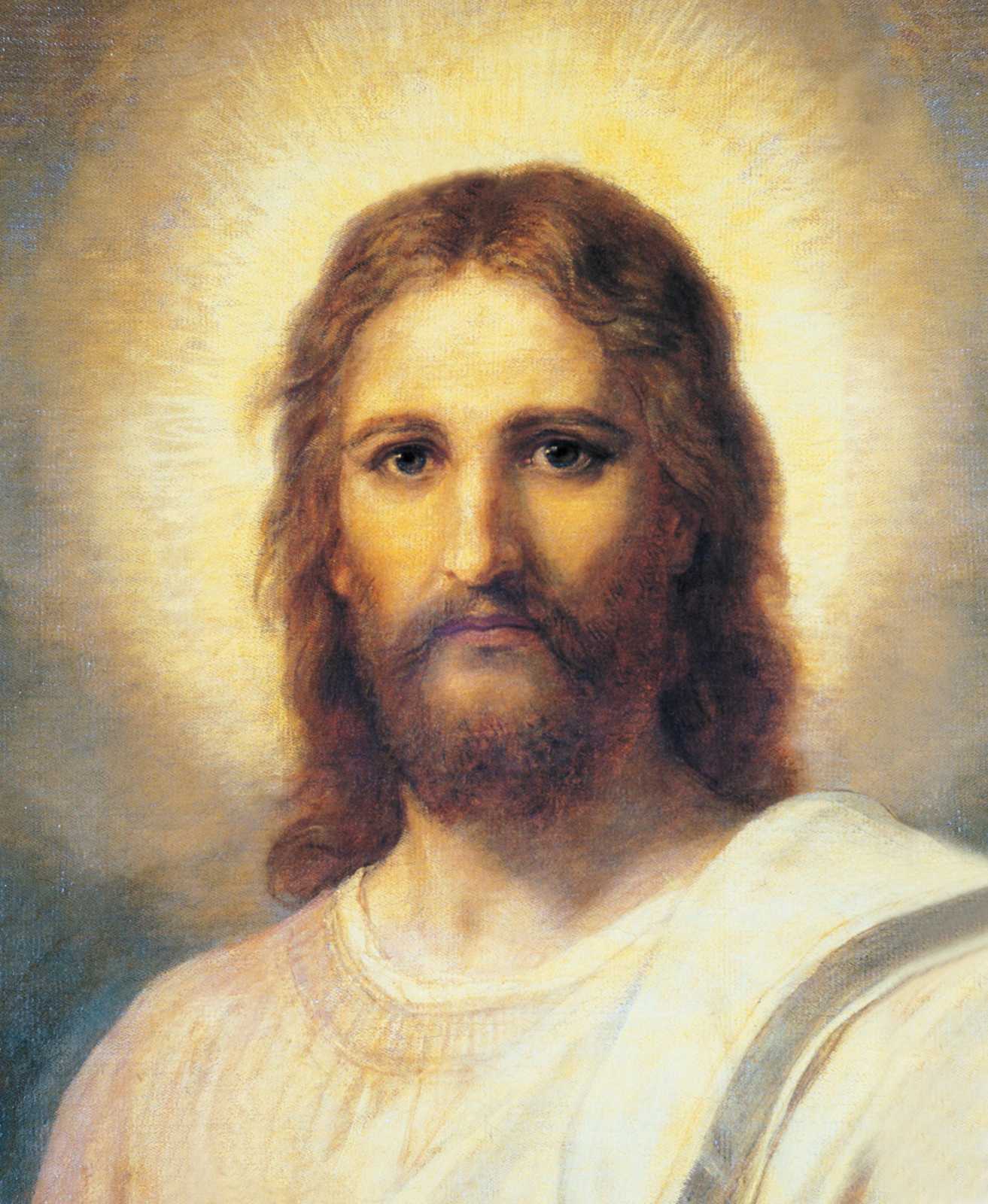
and where could you seek God, but in His own temple, and what is the temple of the living God, but the living temple that He Himself has fashioned—your own heart? I saw, my son, that you went astray, but I want to see it no longer. I have brought you to your own self. I have led you into yourself. For here have I chosen my palace and my dwelling. If you want to dwell with me here, you will find here what you have vainly sought on earth:  rest, comfort, glory, and abundance of all things. This I promise you, my son, that you will not be deceived here as you were there in the world.” 

Christ’s words to Komensky confirm a concept often repeated in the New Testament letters, “Christ in you” (e.g., Col. 1:17). And it confirms many Old Testament verses too. That is because it may well be said that the entire aim of God as recounted in the Bible is to once again bring human beings into fellowship with Himself as it wasand perhaps even better than it wasbefore the Fall. 

As with many of our selections this one is taken from The Protestant Mystics, selected and edited by Anne Fremantle, with an introduction by W. H. Auden. Boston: Little, Brown and Co., 1964. I have modernized some of the syntax and vocabulary for contemporary readers.

The Pilgrim Desires to Flee from the World

John Amos Komensky was born in 1592 in Moravia.  Well educated at several European universities, he became minister of a church at Fulneck, Moravia.  War caused him to flee to Brandeis but his wife and children died along the way.  In a hut in Brandeis he wrote the spiritual masterpiece from which our selections are taken, The Labyrinth of the World and the Paradise of the Heart.  

The wars in Europe continued to harass Komensky all his life.  He lived in Silesia, then England, where the civil war in 1642 forced him to move to Sweden.  He was appointed Moravian (Unity) Bishop of Lissa in 1648. Poland and Sweden began to fight, resulting in Komensky’s home and library being destroyed by fire.  He moved to Amsterdam. He died there and is buried at the church of the French Protestants.  Following the scholarly custom of the day, Komensky took a Latin name, Comenius, by which he is found in most historical writings.

According to the Encyclopedia of World Biography, Komensky is considered the father of modern education.  He advised Protestant governments all over Europe.  He was the first to promote universal education, picture books for children written in their native tongues (instead of Latin), and other innovations.  His life belies the notion that those who believe in heaven and hell do not focus on improving life on earth. 

This selection is one of those that is not happy and bright.  But, to paraphrase C. S. Lewis, the “good news” of Christ does not begin with comfort and affirmation. Hang on; our next installment continues with Komensky’s vision of Christ.

John Amos Kemensky, from The Labyrinth of the World, Chapter 26

(The Pilgrim beholds the Dying and Dead. The Bottomless Abyss beyond the World.)

3. Looking now about me, I behold the ways of the dying, of whom there were many; and I see a mournful thing–to wit, that all gave up the ghost with horror, lamentation, fear and trembling, knowing now what would befall them and whither they would go. Although I was afraid, yet wishing to ever acquire more knowledge, I walked through the rows of the dead to the limits of the world and of light. Here, where others, shutting their eyes, blindly cast forth their dead, I threw off the glasses of Falsehood, rubbed my eyes, and leaned forward as far as I dared. And I behold awful darkness and gloom, of which the mind of man can find neither the end nor the ground; and there was here naught but worms, frogs, serpents, scorpions, rottenness, stench, the smell of brimstone and pitch that overwhelmed body and soul, generally unspeakable horror. 

(The Pilgrim falls to the Ground terrified.)

4. Then My bowels quaked, my whole body trembled, and, terrified, I fell swooning to the ground, and cried mournfully: “Oh, most miserable, wretched, unhappy mankind! This then, is your last glory! This the conclusion of your many splendid deeds! This the term of your learning and much wisdom over which you glory so greatly! This the rest and repose that you crave after countless labors and struggles! This the immortality for which you ever hope! Oh, that I had never been born, never passed through the gate of life! For after the many vanities of the world, nothing but darkness and horror are my part! O God, God, God! God, if you are a God, have mercy on wretched me!”

Undiscovered continents of spiritual living

Frank Laubach

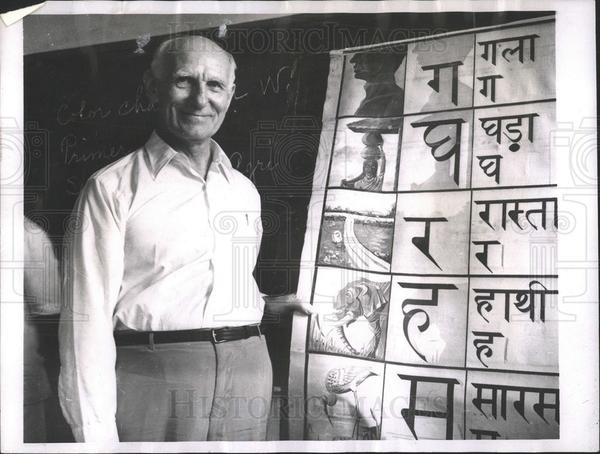
Frank Laubach suffered intense loneliness and deprivation as a missionary among the Moslems of the southern Philippines.  He wrote letters home to his father and described his “experiment” of living every moment in the presence of God. “I determine not to get out of bed until that mind set up on the Lord is settled.”  Things began to change. By the end of his long life he was among the best known and loved men of the world. For one thing, he had been instrumental in teaching millions of people to read. 

Frank Laubach, Letters from a Modern Mystic

January 29, 1930

I feel simply carried along each hour, doing my part in a plan which is far beyond myself. This sense of cooperation with God in little things is what so astonishes me, for I never have felt it this way before. I need something, and turn round to find it waIting for me. I must work, to be sure, but there is God working along with me. God takes care of all the rest. My part is to live this hour in continuous inner conversation with God and in perfect responsiveness to his will, to make this hour gloriously rich. This seems to be all I need think about. 

March 1, 1930

…Perhaps a man who has been an ordained minister since 1914 ought to be be ashamed to confess that he never before felt the joy of complete hourly, minute by minute—now what shall I call it?—more than surrender. I had that before. More than listening to God. I tried that before. I cannot find the word that will mean to you or to me what I am now experiencing. It is a will act. I compel my mind to open straight out toward God. I wait and listen with determined sensitiveness….

rainier-ridao-600681-unsplashBut why do I constantly harp upon this inner experience? Because I feel convinced that for me, and for you who read, there lie ahead undiscovered continents of spiritual living compared with which we are infants in arms. 
–Photo by Rainier Ridao on Unsplash

And I must witness that people outside are treating me differently. Obstacles which I once would have regarded as insurmountable are melting away like a mirage. People are becoming friendly who suspected or neglected me. I feel, I feel like one who has had his violin out of tune with the orchestra and at last is in harmony with the universe. ivan-torres-376149-unsplash

Photo by ivan Torres on Unsplash

As for me, I never lived, I was half, dead, I was a rotting tree, until I reached the place where I wholly, with utter honesty, F Laubachresolved and re-resolved that I would find God’s will and I would do that will though every fibre in me said no, and I would win the battle in my thoughts. I do not claim success even for a day yet, not complete success all day, but some days are close to success, and every day is tingling with the joy of a glorious discovery. That thing is eternal. That thing is undefeatable. You and I shall soon blow away from our bodies. Money, praise, poverty, opposition, these make no difference, for they will all alike be forgotten in a thousand years. But this spirit which comes to a mind set upon continuous surrender, this spirit is timeless life.

From Frank Laubach, Letters from a Modern Mystic.


“Their mind is changed and passes into lasting melody”

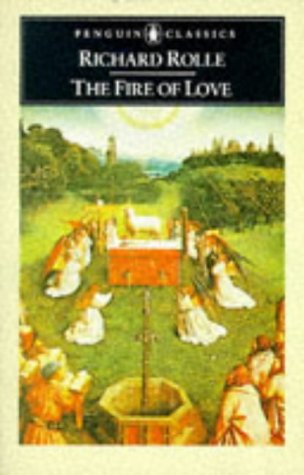
Another entry from Richard Rolle’s 14th century Christian classic, The Fire of Love.  A glimpse of the afterlife. There is no greater image of heavenly joy and flourishing than music. 

The Fire of Love, chapter 5

Therefore all those who are filled with love and joy, the seekers after inextinguishable heat, unite to sing in one glorious choir of rich melody; and now this company of friends has the shade of heaven to protect them against the scorching of lustful flattery and ill will. The very fervour of their sweet love ravishes them with the sight of their Beloved. Flowering through this loving flame into all virtue they rejoice in their Maker. Their mind is changed and passes into lasting melody. From now on their meditations become song. Melancholy has been driven out of the mansion of their spirit, and it now resounds with wondrous melody. The one-time torment of their soul has vanished, and now in glowing health they dwell in the heights of harmony, in the wonderful rhythm of sweet and melodious meditation. 

–Translation and copyright 1972 by Clifton Wolters. Penguin Classics.

Surprised by Fire

f-FB DoveHeart copy

I didn’t know about a connection to the royal wedding until just now. Rev. Michael Curry’s sermon at that historic event has an ancient and deeply spiritual heritage.  Here is a second passage from Richard Rolle’s 14th century spiritual classic, The Fire of Love.  The prologue is one of the few places where Rolle speaks of the personal aspect of his experience plainly, not using generalities about “they” and “those” who experience the fire of love. 

Note the similarities to the brief, intermittent experiences of C. S. Lewis with which I began this blog.  Lewis wrote of his childhood experiences of Joy as “…an unsatisfied desire which is itself more desirable than any other satisfaction…. [I]t might almost equally well be called a particular kind of unhappiness or grief. But then it is a kind we want.”  We also cannot ignore the momentous conversion experience of John Wesley, when he felt his “heart strangely warmed.”

I will write more in an afterword below. You want to get right to Rolle.

The Fire of Love: Prologue

I cannot tell you how surprised I was the first time I felt my heart begin to warm. It was real warmth too, not imaginary, and it felt as if it were actually on fire.  I was astonished at the way the heat surged up, and how this new sensation brought great and unexpected comfort. I had to keep feeling my breast to make sure there was no physical reason for it! But once I realized that it came entirely from within, that this fire of love had no cause, material or sinful, but was the gift of my Maker, I was absolutely delighted and wanted my love to be even greater. And this longing was all the more urgent because of the delightful effect and the interior sweetness which this spiritual flame fed into my soul. Before the infusion of this comfort I had never known such warmth, so sweet was the devotion it kindled. It set my soul aglow as if a real fire was burning there.

Yet as some may well remind us, there are people on fire with love for Christ, for we can see how utterly they despise the world, and how wholly they are given over to the service of God. If we put our finger near a fire we feel the heat; in much the same way a soul on fire with love feels, I say, a genuine warmth. Sometimes it is more, sometimes less: it depends on our particular capacity.

What mortal man could survive that heat at its peak–as we can know it, even here–if it persisted? He must inevitably wilt before the vastness and sweetness of love so perfervid, and heat so indescribable. Yet at the same time he is bound to long eagerly for just this to happen: to breathe his soul out, with all its superb endowment of mind, in this honeyed flame, and, quit of this world, be held in thrall with those who sing their Maker’s praise.

But some things are opposed to love [caritas, i.e., divine, unselfish love]: carnal, sordid things which beguile a mind at peace. And sometimes in this bitter exile physical need and strong human affection obtrude into this warmth, to disturb and quench this flame (which metaphorically I call “fire” because it burns and enlightens). They cannot take away what is irremovable, of course, because this is something which has taken hold of my heart. Yet because of these things this cheering warmth is for a while absent. It will reappear in time, though until it does I am going to be spiritually frozen, and because I am missing what I have become accustomed to, will feel myself bereft. It is then that I want to recapture that awareness of inner fire which my whole being, physical as well as spiritual, so much approves; with it it knows itself to be secure.  

–From Prologue in The Fire of Love by Richard Rolle. Translation and copyright 1972 by Clifton Wolters. Penguin Classics.

Afterword

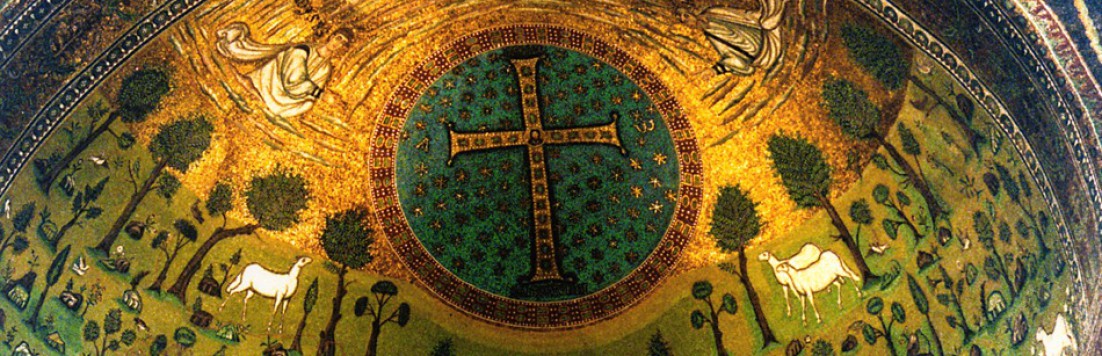
Fire of Love-fig_07-st_apollinare_in_classe

Rolle says here that he uses “fire” metaphorically because it both burns and enlightens. Who would want to experience a “burning” sensation? Yet when we desire something or someone deeply, the sensation is more like a burning than anything else, isn’t it?  —As thousands of poems and pop songs testify.  Not a “heartburn” that you simply want to go away; more like a boiling that says “Something has got to happen; either I am going to explode in song and dance or I am going to quench this fire.”  God is the greatest object of desire, the deepest satisfaction of the soul. It makes sense that desire for Him would be greater than any other desire.  I tend to think of desire-love as eros, following C. S. Lewis’s description in his book The Four Loves, and thus second-rate compared to agapé or divine, self-sacrificing love, which does what is best for the beloved, not seeking satisfaction of one’s desire.  But Rolle and similar mystics bring me up short.  How can this fire of love be a divine form of love if it is desire? 

So this is a paradox.  Perhaps we might say that this “fire of love” is a kind of “eros” transfigured, desire for something that nothing in this world can satisfy but still cousin in its bodily sensations to earthly desires.

And this seems to be what Rolle is indicating.  Augustine or others are often credited with writing “Each person has a God-shaped hole that only God can fill,” and Pascal did say something along these lines.  But actually, the thought originated with Rolle in this book: “Since the human soul is capable of receiving God alone, nothing less than God can fill it; which explains why lovers of earthly things are never satisfied” (chapter 11).

And this is a fire that drives us to agapé, which is action not feeling.  It drives us to “Love the Lord your God with all your heart, and mind, and strength, and love your neighbor as yourself.”

Have you every experienced the fire of love?

P.S.:  I began this series not having watched any of the Royal Wedding. I just learned that the Presiding Bishop of the Episcopal Church Michael Curry gave a “fiery” (at least for a royal wedding) sermon on The Fire of Love.  Though his focus was not our love for God, many of his thoughts are still relevant.  And since I will probably get 396,481 new visitors to this site, I will link and tag it here, nudge nudge, wink wink. (“OMG, he’s sold out.”)

Someone to Meet in the Next World

One of the most astonishing accounts in modern times is Dr. Eben Alexander’s Proof of Heaven.  It made a splash when published in 2012, because this was a near-death experience (NDE) unlike any other.  Beforehand, Alexander was a skeptic about the after-life and about NDEs.  He was an unsentimental and successful neurosurgeon who believed, like many in the medical community, that NDEs were hallucinations created by neuro-transmitters continuing to fire in the brain when consciousness ceased.  But his own illness seemed specifically designed to undermine that theory.  He was suddenly overcome by a rare meningitis that not only placed him in a coma but shut down his brain.  All the specialists involved told his family that if he ever recovered from his coma he would be a vegetable.  After a week they were just about to “pull the plug” when he opened his eyes and began talking.  He was completely cured and no one could understand how.  But we might understand the why.  I have not finished the book yet much less rendered a decision on how kosher its theology is.  But Alexander’s life since then reminds me of Mark Helprin’s epigram to Winter’s Tale:

I have been to another world, and come back. Listen to me. 

Near the beginning of his experience, Alexander finds himself flying without an aircraft over a paradisical land. Assuming it is true and not a hallucination it reminds us that mystic wonder has more to do with people than place.  And it gives a rock solid glimpse of what “higher and holier” means. 

Proof of Heaven

Someone was next to me: a beautiful girl with high cheekbones and deep blue eyes.  She was wearing the same kind of peasant-like clothes that the people in the village down below wore. Golden-brown tresses framed her lovely face….

The girl’s outfit was simple, but its colors–powder blue, indigo, and pastel orange-peach–had the same overwhelming, super-vivid aliveness that everything else in the surroundings had.  She looked at me with a look that, if you saw it for a few moments, would make your whole life up to that point worth living, no matter what had happened in it is so far.  It was not a romantic look.  It was not a look of friendship. It was a look that was somehow beyond all these…beyond all the different types of love we have down here on earth.  It was something higher, holding all those other kinds of love within itself while at the same time being more genuine and pure than all of them.

In the end of the book, Dr. Alexander, who was adopted as a baby, is given an old photo and discovers this girl is his birth-sister whom he never knew.

See it on Amazon

Proof of Heaven: A Neurosurgeon’s Journey to the Afterlife, by Dr Eben Alexander.  New York: Simon & Schuster, 2012.  Copyright 2012 by Dr. Eben Alexander.  All rights reserved.

Exodus 19: The Deadly Presence of Holiness

This is the type of mystical experience that leaves us in fear and trembling. This passage is the Grandaddy of that type.

mount-sinai-egypt-moses-1244104-wallpaperIn the middle of the desert a lone mountain rises up.  It is called Sinai. The Israelites camp at the base, and Moses climbs up. Somewhere along the way, God calls from the mountain. God tells Moses to remind the people below how God rescued them from the Egyptians to “be my own little flock….a kingdom of priests to God, a holy nation.”  The context is important. God appears with fire and thunder in the passage below, and then he gives to Moses the commandments for creating that reverent and just society: a holy nation. 
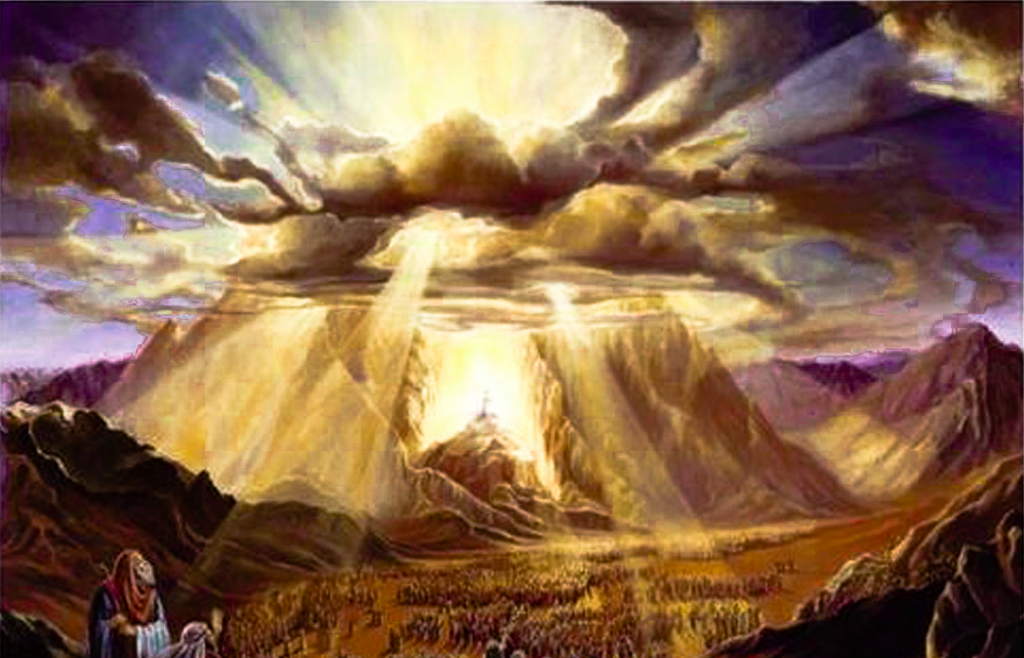
God appears once again without disguise, even the disguise of a burning bush.  This aspect of holiness that we see in Exodus 19 is unpopular or unknown these days, even despised–even among Christians, Jews, and Muslims, sometimes.  To believe someone is so different from us, so set apart (one of the meanings of “holy”), so much better than we are, may defy our democratic principles. It certainly hurts our egos.Exodus-19-21-1024x658

But unless we understand this aspect, we cannot understand how infinitely morally good God is compared to us. But when we do understand it, we also get a glimpse of how much love and humility is poured out in the life and death of Jesus Christ.  We understand why we need Jesus, why he is “the way, the truth, and the life,” the end as well as the means. We understand that only a man who was God, and a God who would become a man, could bridge that awe–full gap between us and God. 

Exodus 19

Moses returned from the mountain and called together the leaders of the people and told them what the Lord had said.

They all responded in unison, “We will certainly do everything he asks of us.” Moses reported the words of the people to the Lord.

Then [God] said to Moses, “I am going to come to you in the form of a dark cloud, so that the people themselves can hear me when I talk with you, and then they will always believe you. Go down now and see that the people are ready for my visit. Sanctify them today and tomorrow, and have them wash their clothes.  Then, the day after tomorrow, I will come down upon Mount Sinai as all the people watch.  Set boundary lines the people may not pass, and tell them, ‘Beware! Do not go up into the mountain or even touch its boundaries; whoever does shall die— no hand shall touch him, but he shall be stoned or shot to death with arrows, whether man or animal.’ Stay away from the mountain entirely until you hear a ram’s horn sounding one long blast; then gather at the foot of the mountain!”

So Moses went down to the people and sanctified them and they washed their clothing.

He told them, “Get ready for God’s appearance two days from now, and do not have sexual intercourse with your wives.”img_5635

On the morning of the third day there was a terrific thunder and lightning storm, and a huge cloud came down upon the mountain, and there was a long, loud blast as from a ram’s horn; and all the people trembled.  Moses led them out from the camp to meet God, and they stood at the foot of the mountain.  All Mount Sinai was covered with smoke because Jehovah descended upon it in the form of fire; the smoke billowed into the sky as from a furnace, and the whole mountain shook with a violent earthquake.  As the trumpet blast grew louder and louder, Moses spoke and God thundered his reply.  So the Lord came down upon the top of Mount Sinai and called Moses up to the top of the mountain, and Moses ascended to God.

But the Lord told Moses, “Go back down and warn the people not to cross the boundaries. They must not come up here to try to see God, for if they do, many of them will die. Even the priests on duty[a] must sanctify themselves, or else I will destroy them.”